Seat Depth Measurement Guide for Gaming Chairs
By Aisha Karim • 15th Feb
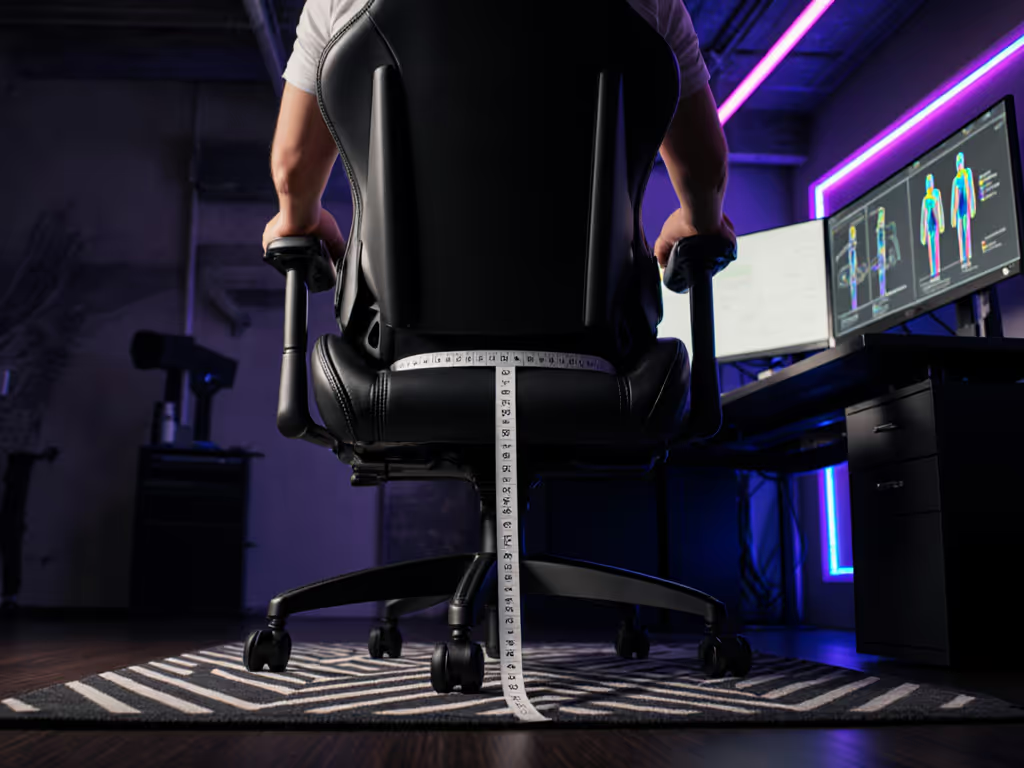
Proper seat depth is the distance from the back of your chair's seat pan to its front edge, and it is one of the most overlooked variables in adjustable seat depth choices for office chairs. A seat that is too deep will press into your knees and thighs during extended gaming sessions; a seat that is too shallow leaves your lower back without thigh support, forcing your spine to carry a load it shouldn't. This seat depth measurement guide walks you through the anthropometrics, the step-by-step protocol, and the decision logic you need to match your body to a chair that actually fits.
Understanding Seat Depth and Its Role in Comfort
Why Seat Depth Matters
When you sit, your body's weight distributes across three primary zones: your buttocks, your thighs, and your back. Seat depth controls how much of your thigh receives support and, critically, where pressure concentrates at the edge of the seat pan. Pressure maps don't lie; your body writes the spec sheet.[1] To understand how seat depth interacts with lumbar positioning and overall alignment, see our spinal alignment guide. If the seat edge digs into the back of your knee (the popliteal fossa), you will experience numbness, tingling, or outright pain within two to four hours, precisely when your competitive focus or creative output should be peaking.
I spent my first week pressure-mapping chairs and observed a pattern that changed how I evaluate any seat: a bucket-style seat with a deep, aggressive pan created two angry red hotspots behind the thighs by hour three, even on a player with an optimal popliteal height. After swapping to a flatter pan and reducing the seat depth by 1.5 inches, the same player sat for five hours without pressure markers. Same gamer, same session length, less pain, cooler temperatures, measurable improvement in focus stability.
Proper seat depth for gamers redistributes load across a longer thigh surface and prevents the edge-pressure phenomenon that breaks concentration and stalls recovery between sessions.
The Biomechanical Target
According to the ISO 9241-5:2024 standard for ergonomic seating, seat depth should be less than your buttock-popliteal length (the distance from your tailbone to the back of your knee while seated) by 3-5 centimeters.[1] This clearance gap, typically 2-4 centimeters when you sit back fully against the backrest, allows your thighs to rest without edge pressure while keeping your back anchored for lumbar support.
How to Measure Your Ideal Seat Depth
The Buttock-Popliteal Length Protocol
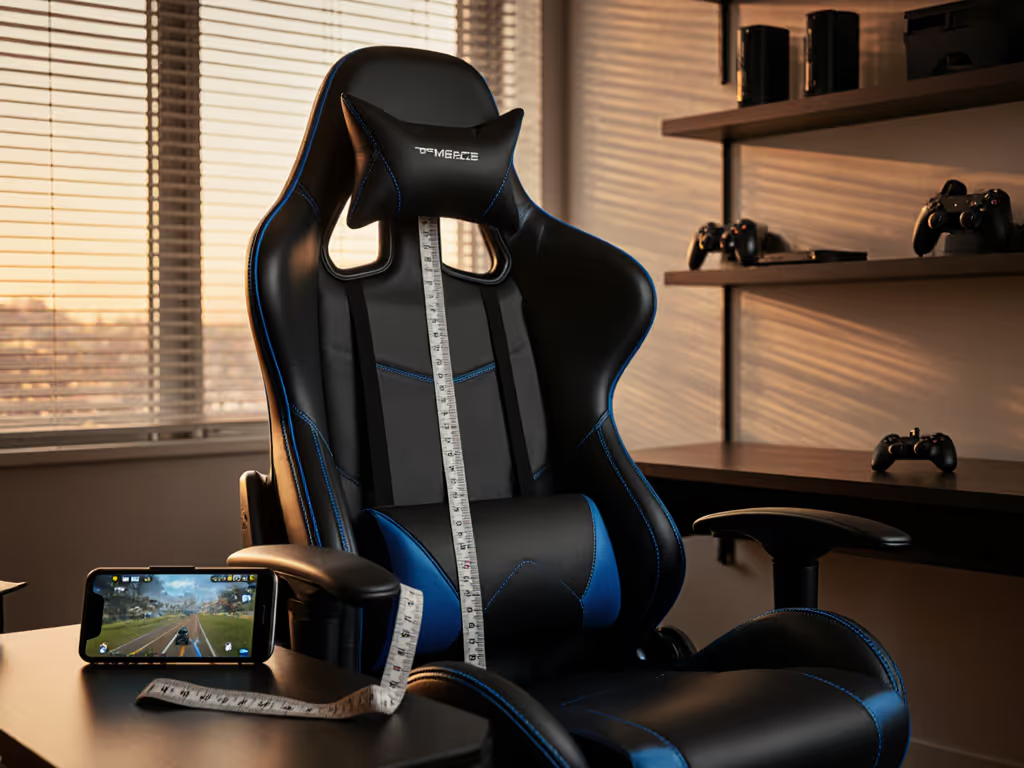
This is the foundational measurement for seat depth selection. You'll need a tape measure, a wall, and a standard chair (dining, desk, or office).
Test variables: Measure in relaxed clothing and normal footwear; room temperature 20-22 °C (68-72 °F); time of day after any swelling has normalized (late morning is typical).
Step-by-step procedure:[1]
- Sit upright on your reference chair with your hips pressed against a wall.
- Place the tape measure's zero point against the wall at the level of your tailbone.
- Run the tape horizontally under your thigh to the popliteal crease - the bend at the back of your knee.
- Record this distance in both centimeters and inches.
Example: If your buttock-popliteal length measures 48 cm (18.9 in), your ideal seat depth is 43-45 cm (16.9-17.7 in).
Alternative Measurement: Knee-to-Seat Protocol
If you prefer to measure directly on a chair you own or can test, this method works well for cross-checking fit:[2][4]
- Sit on the chair with your back fully against the backrest.
- Bend your knees at a natural angle (110-120 degrees).
- Measure the distance from the back of your knee (popliteal point) to the front edge of the seat pan.
- If this gap is 2-4 cm (0.8-1.6 in), the seat depth is correct.
- If the gap is zero or negative (your knees touch or press the edge), the seat is too deep.
Translating Measurements into Spec-Sheet Decisions
Fixed vs. Adjustable Seat Depth
When reviewing a great gaming chair, check the manufacturer's specification sheet for one of two scenarios:
Fixed seat depth chairs: These offer one depth only. Calculate your target depth (buttock-popliteal length minus 3-5 cm) and verify the chair's spec falls within your range. A compact player (160 cm / 5'3") with a buttock-popliteal length of 44 cm needs a seat depth of 39-41 cm (15.4-16.1 in).[1] Most standard gaming chairs, designed for 175 cm (5'9") average frames, will be too deep and unsuitable.
Adjustable (sliding) seat depth chairs: These allow you to move the seat pan forward or backward. Look for an adjustment range that spans your ideal depth plus or minus at least 2 cm.[1] If your ideal depth is 43-45 cm, a chair offering 40-48 cm of adjustment range gives you control to fine-tune as your session length and posture preferences evolve.
The Anthropometric Fit Table
Use this reference to cross-check your measurements and understand what to expect:
| Body Measurement | How to Measure | What to Look for on Spec Sheet |
|---|---|---|
| Buttock-popliteal length | Sit hips against wall; tape from tailbone to back of knee under thigh | Seat depth = your length - 3-5 cm (yields 2-4 cm clearance) |
| Popliteal height | Sit feet flat; measure from floor to back of knee | Ideal seat height = popliteal height + 2-4 cm |
| Lumbar height (L3-L4 spinal segment) | Sit upright; measure from seat surface up to the natural curve of lower back | Lumbar support peak 16-24 cm above seat; pad 3-5 cm thick |
| Shoulder breadth | Measure across shoulders while seated, relaxed posture | Backrest width ≥ shoulder breadth + 4-6 cm clearance |
| Hip breadth | Measure across hips while seated | Seat width (including bolsters) ≥ hip breadth + 4-6 cm clearance |
Three Body Types and Seat Depth Fit Profiles
Compact Players (~160 cm / 5'3")
Key metrics:[1]
- Buttock-popliteal length: ~44 cm → Ideal seat depth 39-41 cm (15.4-16.1 in)
- Popliteal height: ~36 cm → Ideal seat height 38-40 cm (15-15.8 in)
Fit challenge: Most "standard" gaming chairs have seat depths of 17-19 in, which will press into the back of the knees. Many also have minimum seat heights of 42-45 cm, forcing the legs into a compressed angle.
Practical approach: Prioritize chairs explicitly marketed for petite frames or XS/Small sizes, or select adjustable-depth models with a lower depth range (16-18 in maximum). Verify the seat height minimum meets your popliteal height plus 2-4 cm. For a full breakdown of petite-friendly dimensions and model picks, read our petite gaming chair fit guide.
Average Players (~175 cm / 5'9")
Key metrics:[1]
- Buttock-popliteal length: ~48 cm → Ideal seat depth 43-45 cm (16.9-17.7 in)
- Popliteal height: ~42 cm → Ideal seat height 44-47 cm (17.3-18.5 in)
Fit challenge: Moderate range in seat depth. Many standard gaming chairs fit this range well, but overly deep seats (18.5+ in) become problematic past the 2-hour mark.
Practical approach: Standard Medium or Regular sizes typically fit well. Confirm seat depth is not marketed as "extra-deep" and check that the adjustment range (if available) centers on your ideal depth, not the upper limit.
Tall Players (~190 cm / 6'3")
Key metrics:[1]
- Buttock-popliteal length: ~53 cm → Ideal seat depth 48-50 cm (18.9-19.7 in)
- Popliteal height: ~47 cm → Ideal seat height 49-52 cm (19.3-20.5 in)
Fit challenge: Few off-the-shelf chairs offer seat depths ≥19 in or seat heights ≥50 cm. Standard Large or XL sizes may reach height but compromise depth.
Practical approach: Seek chairs explicitly rated for 190 cm+ heights. Confirm both seat depth and seat height minimums meet your specs. If depth is slightly short, a back cushion (2-4 cm thick) placed low can extend effective depth without adding pressure at the edge.[1] See our tested big and tall chair recommendations with verified seat depth and backrest height data.
Common Misconceptions and Pitfalls
Misconception 1: "Deeper Seat = More Support"
A common pitch is that a deeper seat provides more support and a "throne-like" feel. In reality, deep seats create edge pressure, reduce thigh circulation, and force you to sit forward to avoid knee contact, precisely the posture that collapses lumbar support and causes back fatigue.
Adjustability is a system, not a single feature; depth is one lever among seat height, lumbar position, and armrest alignment. A moderately deep seat (3-5 cm clearance from your knee) paired with strong lumbar support and proper arm height will outperform a deep seat with weak adjustability.
Misconception 2: "One Size Fits Most Gamers"
Body diversity, in leg length, torso length, shoulder width, and weight distribution, is real and measurable. A 5'3" player and a 6'3" player have buttock-popliteal lengths differing by ~9 cm (3.5 in), yet many budget chairs offer a single fixed seat depth. Inclusive gaming chair ergonomics means offering XS, S, M, L, and XL variants with corresponding depth ranges, not marketing one depth as universal.
Misconception 3: "Adjust Seat Height High Enough and Depth Doesn't Matter"
Raising seat height creates a steeper hip-knee angle, which can open the angle at the popliteal crease and temporarily reduce edge pressure. However, raising the seat also:
- Lifts your elbows above desk height, forcing your shoulders upward and straining the upper trapezius over hours.
- Creates a dangling feet position if your popliteal height is not simultaneously accommodated.
- Shifts your center of gravity forward, compromising spinal stability.
Seat depth and seat height are interdependent adjustments; neither is a substitute for the other.
Real-World Fit Verification and Adjustments
Testing Depth Before Purchase
If you can sit in the chair before buying, use this protocol:
Test conditions: Wear gaming attire; bring a phone or laptop to the test location; plan for a 20-30 minute sit, not a 2-minute demo.
Verification steps:
- Adjust seat height so your feet rest flat and your thighs are parallel to the floor.
- Sit back fully against the backrest.
- Slide your hand under the back of your knee; there should be 2-4 cm (one to two finger widths) of clearance.
- Lean forward slightly into your gaming posture; repeat the clearance check. Pressure should not increase.
- Note any hotspots, numbness, or pressure ridge sensations. These will amplify over 3-5 hours.
Correcting a Seat That Is Slightly Too Deep
If a chair's fixed depth is 1-2 cm deeper than ideal, real-world installers use these strategies:[1]
- Add a back cushion (lumbar pad or coccyx cushion): Placed at the seat surface level, a 2-4 cm thick cushion effectively reduces the depth you experience without replacing the seat. Ensure the cushion's top edge does not create a new pressure point at the mid-thigh.
- Use a footrest or leg rest: If the seat cannot be changed, a footrest that tilts your knees slightly upward opens the popliteal angle and can reduce edge pressure. Test this over a full session to confirm relief. For proven add-ons that improve pressure distribution, check our gaming chair accessories guide.
Correcting a Seat That Is Slightly Too Shallow
If a chair's depth is 1-2 cm shallower than ideal:
- Adjust your seating position: Sit slightly forward so your thighs receive more pan support, while ensuring your lumbar spine still contacts the backrest support. This is a temporary compromise, not a permanent solution.
- Check seat height balance: A seat height that is too high can make a shallow depth feel even shallower. Verify your popliteal height is correct first.
How to Measure Seat Depth: A Streamlined Checklist
When evaluating a new chair for seat depth fit:
- Measure your buttock-popliteal length at home using the wall protocol (tape from tailbone to back of knee under thigh while seated hips against wall).
- Calculate your target depth range: buttock-popliteal length minus 3-5 cm.
- Check the manufacturer's spec sheet for seat depth in centimeters or inches.
- Verify the depth falls within your range. If fixed depth, it must match. If adjustable, the range must include your target and allow +/- 2 cm fine-tuning.
- Cross-check against your height and body type using the three-profile reference above.
- If possible, sit test for 20-30 minutes in your gaming posture and check for knee clearance and pressure hotspots.
- Plan for adjustments: If depth is slightly off, have a back cushion or footrest on hand to tune after arrival.
Depth in the Context of Overall Chair Fit
Seat depth does not operate in isolation. Your final comfort depends on the interaction of:
- Seat height alignment with popliteal height and desk height
- Lumbar support peak position (should sit 16-24 cm above seat, matching your L3-L4 spinal segment)
- Armrest height and adjustability (should align with your seated elbow height, ideally 24-28 cm above seat for average adults)
- Seat width and bolster geometry (should provide 4-6 cm clearance on either side of your hips)
- Backrest angle and recline tension (should support your preferred gaming angle without forcing a fixed posture)
- Material and thermal properties (breathable fabrics maintain consistent pressure distribution over long sessions)
When you dial in seat depth using this guide, you're setting a foundation. Layer in proper height, lumbar position, and armrest fit, and you shift from a chair that "fits" to one that performs, one where your focus outlasts the session because your body is not fighting pain or distraction.
Next Steps for Personalized Fitting
With your buttock-popliteal length and target depth range in hand, the next phase is cross-referencing seat height, popliteal height, and desk height to ensure the entire kinetic chain aligns. Measure your elbow height while seated at your desk or gaming station, then use that to verify armrest range. Then follow our chair and monitor adjustment guide to dial in posture for long sessions. Document your shoulder breadth and hip breadth for seat width assessment.
If you are in a body type outlier category (petite, very tall, or heavier), explicitly search for brands offering XS, S, or XL variants with published depth ranges that match your spec, rather than assuming a Medium will work. Read long-session reviews (3+ hours) on user forums where people report actual pressure and temperature outcomes, not first-day impressions.
Finally, if adjustable depth is available in your candidate chair, test the full range during your sit-test. Slide the seat forward and backward; feel where neutral sits. That tactile knowledge will accelerate your tuning once the chair arrives.
Related Articles